Sign up for exclusive content and updates!
You've set the table for everyone else. Now it's your turn.
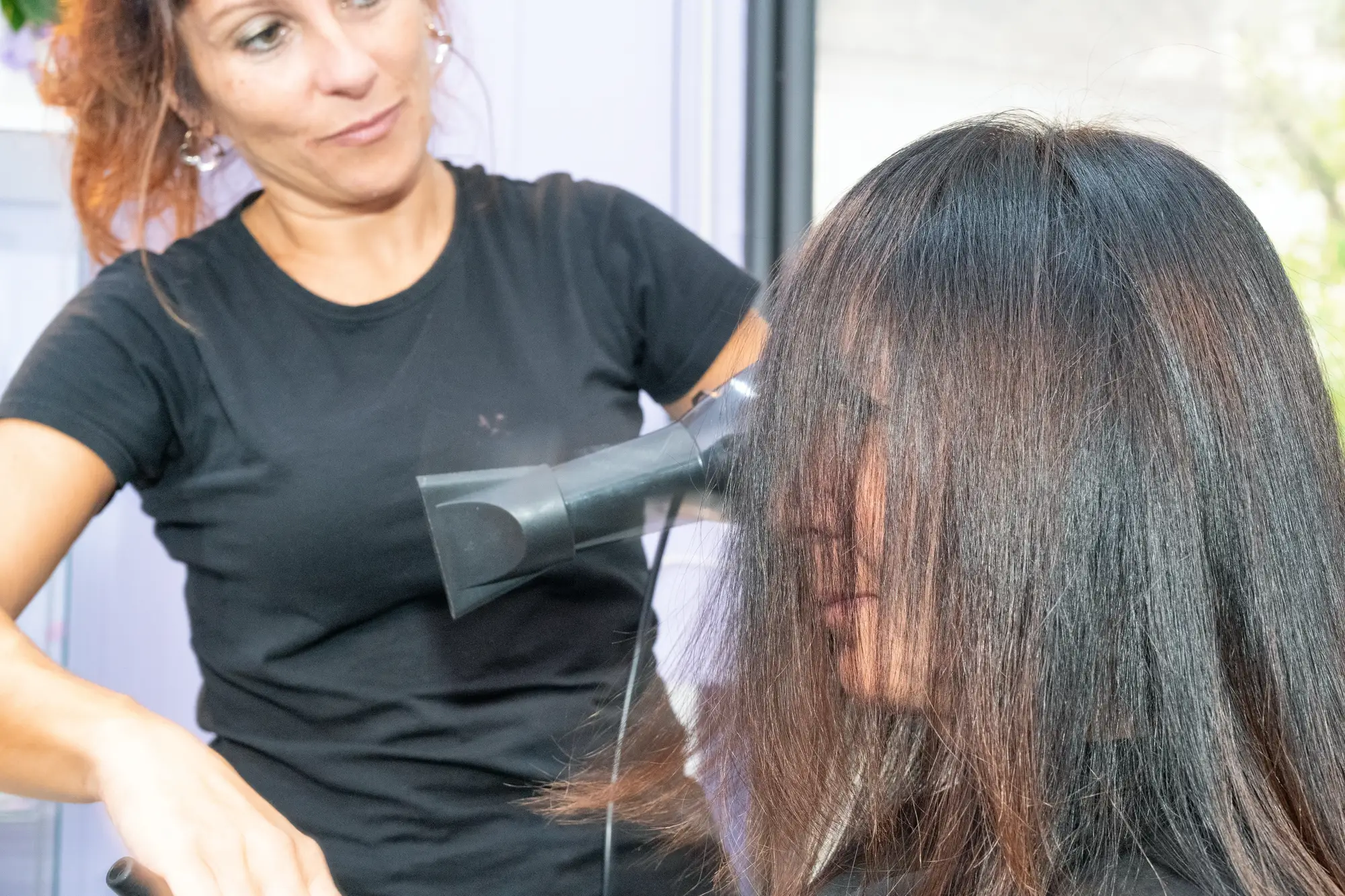
You were tipped back in the chair, half listening to the radio, when she said it. She's been cutting your hair for years, so she said it kindly, the way you'd tell a friend she had lipstick on her teeth. "Your part's opening up a little right here. Have you noticed?"
You hadn't. Or you had, in the way you notice something and then decide not to look straight at it. The extra hair in the drain. The ponytail that used to take three loops of the elastic and now takes four. That photo from your granddaughter's graduation where the light came through the top of your head in a way it never used to.
She saw it six months before you did, because she sees the top of your head far more clearly than you ever will.
Hair thinning after menopause is close to universal, and almost nobody says so out loud. Research on female pattern hair loss puts it at more than half of women by their mid-sixties, and some studies land higher than that. So this isn't a rare bit of bad luck you happened to draw. It's one of the most common experiences of this decade, happening behind a wall of silence, which is exactly why it feels so lonely when it arrives at your own part line.
Estrogen doesn't only handle periods and hot flashes. It also helps hold your hair in its growing phase.
Every strand on your head runs a cycle: it grows for two to six years, rests briefly, falls out, and starts again. Estrogen lengthens that growing stretch. When estrogen drops after menopause, the growing phase shortens, the resting phase stretches out, and each new strand comes back a little finer and a little shorter than the one it replaced. At the same time, the small amount of androgens your body has always produced becomes relatively more influential, and those androgens miniaturize follicles in a specific pattern: the part, the crown, the temples. That's why this reads as widening rather than patches.
There's a second layer that gets almost no attention. After 60, protein intake tends to drop, stomach acid production decreases, and absorption of the B vitamins and minerals that hair depends on becomes less efficient. Your body triages what it has. It will always fund your heart before it funds your hair.
You've probably already worked your way through the salon shelf: volumizing shampoo, thickening mousse, the root spray in the shade closest to your color, the expensive line she recommended at the register.
Here's the mechanical reason those disappointed you. Every one of them works on the strand you already have. They coat it, lift it at the root, or scatter light so the scalp shows less. That's cosmetic camouflage, and there's nothing wrong with it. But not one of them reaches the follicle, which is where the actual change is happening. You were treating the visible half of the problem with tools that can't reach the other half.
And if someone told you to stop stressing about it, that was worse than useless. Stress does affect the hair cycle, but the loss you're seeing started with hormones, not with your attitude.
Biotin is vitamin B7. One of its central jobs in your body is supporting keratin production, which is the structural protein your hair, skin, and nails are literally built from. When biotin runs low, hair gets more fragile, breakage goes up, nails split, and skin loses some of its resilience. Low or borderline levels are more common in women over 60 than most people realize, largely because of the absorption changes I mentioned above, and because several common medications interfere with how much you actually take in.
That's why we recommend a biotin supplement, and why I'd start there before anything else. You can see it here: herowntable.com/biotin. It's a single daily dose, formulated for women in this stage rather than for twenty-year-olds chasing longer hair, and it costs less than one bottle of the salon shampoo that wasn't helping anyway.
Let me be straight with you about what it will and won't do, because I'd rather you trust me than buy something under the wrong impression.
Biotin will not replace the estrogen you've lost, and it won't reverse pattern thinning on its own. What biotin does is make sure the hair you are growing has what it needs to come in stronger and break less, so you stop losing length and density to fragility on top of everything the hormones are already doing. For a lot of women, that difference is the one they can actually see in the mirror.
Two practical things. Give it three to four months, because you're waiting on a growth cycle, not a cream. And take a photo of your part today in ordinary bathroom light, because progress at this pace is invisible day to day and obvious in a side-by-side.
One honest caution: biotin can interfere with certain lab tests, including thyroid panels and cardiac troponin. Tell whoever draws your blood that you're taking it, and stop for a couple of days beforehand if your doctor asks you to.
Part of what stings about that moment in the salon chair is the feeling that you can't take it seriously until a professional confirms it's real, and the next opening is in eleven weeks.
You don't have to wait. Starting biotin today is a legitimate first step you can take on your own, this afternoon, without permission from anyone. Start here.
Do make the appointment too, though, if any of this sounds like you: thinning that came on suddenly over a few weeks, loss in distinct round patches, or thinning alongside fatigue, feeling cold, or brittle nails. Those point toward thyroid trouble or low iron, and both are very treatable once someone actually checks. Ask specifically for a thyroid panel and a ferritin level, not just a standard iron test.
We were handed a beauty industry that talks endlessly about hair and never once mentioned that this would happen at 61, to most of us, at the same time. That silence is not your fault, and neither is your part line. You just needed someone to say it out loud and hand you something that works on the right layer.