
Sign up for exclusive content and updates!
You've set the table for everyone else. Now it's your turn.
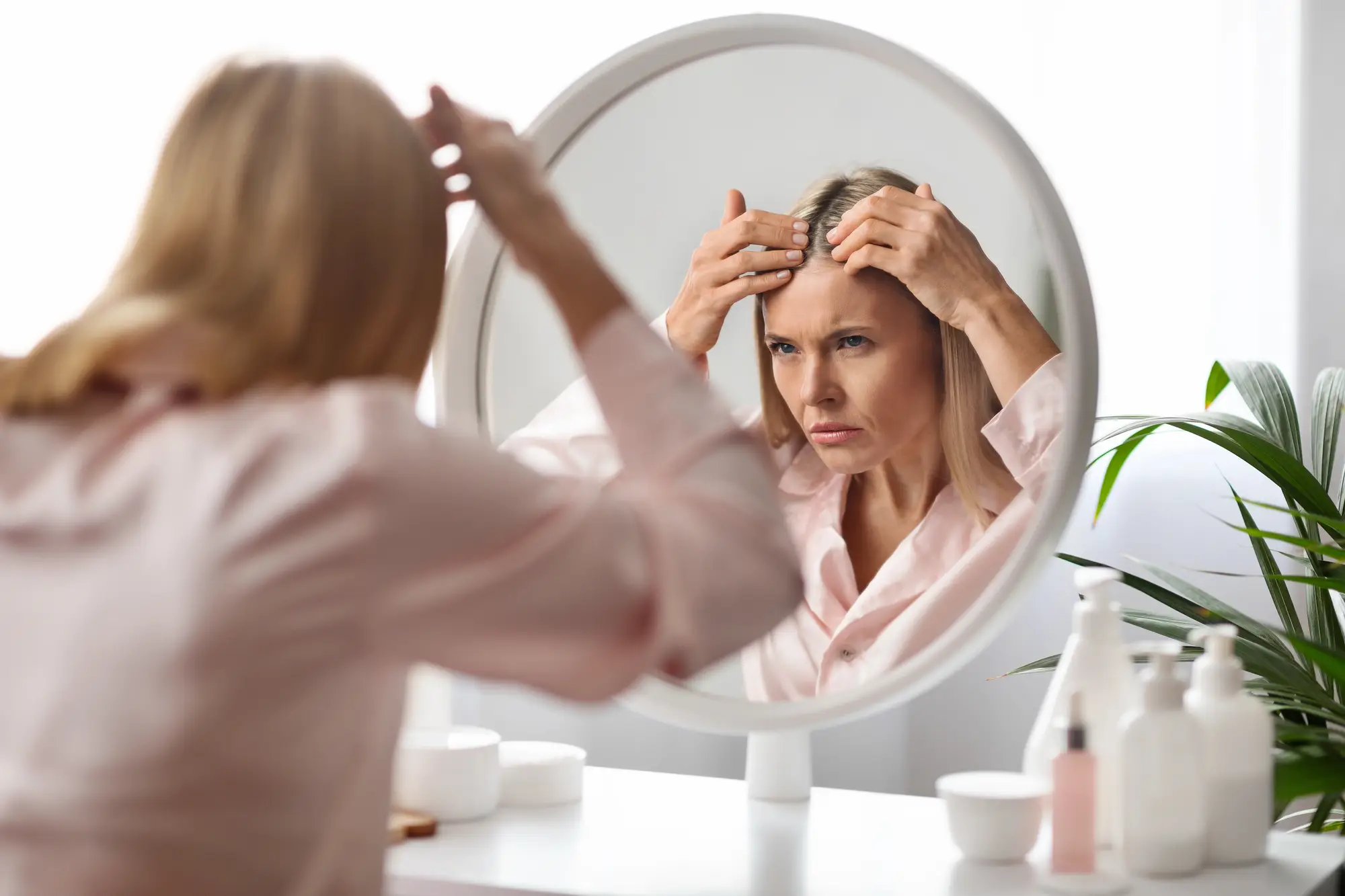
You noticed the hair first, probably. Not falling out in alarming clumps, just thinner at the part, so the scalp shows through in a way it never used to under the bathroom light. Then the skin, which used to bounce back from a dry winter and now seems to hold the dryness like it has decided to keep it. And somewhere in there, the nails started splitting sideways before they ever got long enough to need cutting.
That is three separate things, and three separate trips to three separate aisles. It is how most of us handle it, because it is how the shelves are organized.
Here is what I want to talk through with you, because it took me a while to see it myself: these three things arriving in the same twelve months is not a coincidence, and it is not three problems. It is one change, showing up in the three places on your body that are least able to hide it.
Let me name what you have already tried, because you have tried plenty.
The volumizing shampoo that made your hair feel thicker for about four hours after washing. The three-hundred-dollar serum a very kind woman at a counter explained with a great deal of confidence. The gel manicures that hid the splitting nails and then, once you took them off, revealed nails noticeably worse than when you started. The collagen powder in your coffee for eleven weeks. The hand cream by the sink, in the car, in your purse.
None of that was foolish. Every one of those products addressed the thing you could see. The reason they underdelivered is that they were all working on the outside of something happening several layers underneath, in your metabolism.
Here is the mechanism, and it reorganizes everything.
Hair and nails are made almost entirely of keratin, a structural protein your body has to build from scratch, continuously, for your whole life. Skin needs that same protein-building capacity plus something else: a steady supply of fats. The outermost layer of your skin holds moisture in using a mortar made of lipids, which is the technical word for fats. When your body's fat-processing machinery slows, that mortar thins, and water leaves your skin faster than it used to. That is the dryness you are feeling, and it is why surface moisturizer never fully solves it. You are topping up a bucket with a slow leak.
Now add the part almost nobody connects for you. After menopause, when estradiol (the main form of estrogen your body ran on for forty years) drops away, your metabolism does not simply slow down in the vague way magazines describe. It changes how it handles fats and carbohydrates specifically. Insulin sensitivity changes. Protein turnover changes. Your body starts triaging, and the tissues rebuilding themselves for cosmetic rather than survival reasons go to the back of the line.
Hair, skin, and nails are exactly those tissues. They changed in the same year because they were all downstream of the same event.
Biotin is vitamin B7. It is not a hair vitamin, despite what the packaging implies, and the marketing has genuinely obscured what it does.
Biotin's real job is to serve as a cofactor, which means it is the piece a handful of specific enzymes physically cannot function without. Five of them, and their work is exactly what we have been describing: breaking down and building fats, processing carbohydrates, and handling amino acids, which are the raw pieces of protein. Two of those enzymes start fatty acid synthesis, the process that builds the lipid mortar in your skin barrier.
So biotin is not aimed at your hair. It is a cofactor for the metabolic work that supplies your hair, your skin, and your nails. That is why it can touch all three at once, and why it is the closest thing there is to one lever on what you have been treating as three problems.
I am going to be straight with you, because you have been oversold before.
The strongest evidence is for brittle nails. Small human studies, mostly from the 1990s, found meaningful thickening and less splitting in women taking 2.5 milligrams of biotin daily over roughly six months. Those studies were small and not placebo-controlled, so researchers call the evidence promising rather than settled. For hair and skin, the honest summary is that biotin reliably helps people whose biotin status is low, and the picture is much less clear for people whose levels are already fine.
What makes it worth considering rather than dismissing is that "already fine" is less certain at this life stage than it sounds. Gut absorption changes with age. Long-term antibiotics, certain anti-seizure medications, and regular alcohol all lower biotin status. And if you have been eating less overall, which most of us have, you are taking in less of everything.
Give it three to six months. Hair grows about half an inch a month, and a nail takes roughly six months to fully replace itself. Anything you judge at four weeks, you are judging on old growth.
Take it with food, at the same time every day. It is water soluble, meaning your body stores very little of it, so consistency matters more than the size of the dose.
Tell your doctor before any blood work. This one is important and almost never mentioned: biotin at supplement doses can distort thyroid panels and cardiac troponin tests, sometimes enough to mimic a real condition. Stopping it a few days before a blood draw solves it completely.
If you want a straightforward single-ingredient version, the one I keep coming back to is Pure Biotin, at 5,000 mcg with no fillers or added extras. Single ingredient matters more than it seems, because when you take a blend of fifteen things and something improves, you will never know which one did it.
I keep thinking about how neatly this got sold to us as three separate maintenance failures. Not moisturizing enough. Not being gentle enough with our hair. Not caring for our nails properly.
It was never three failures. It was one change in how our bodies process fat and fuel, and nobody explained it to us, so we have been buying products aimed at its shadows ever since. We are allowed to work on the actual thing instead.